I’ve spent most of my life being the sort of person who runs from spiders rather than toward them. Over the past few years, though, curiosity and a little education have softened that fear into something closer to fascination. Still, that doesn’t mean I want one landing on my face.
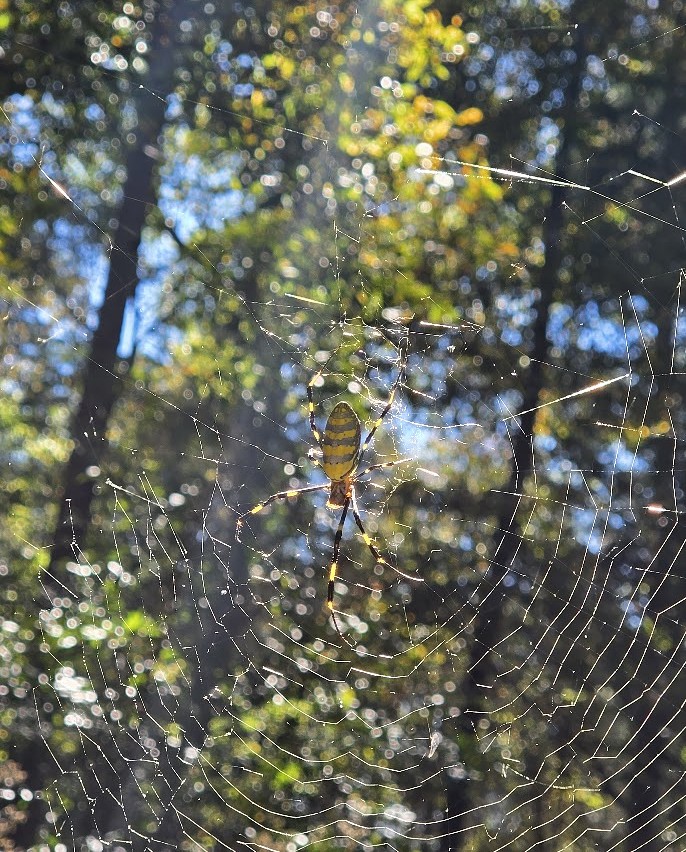
I’m still very aware of spiderwebs when I’m out walking, especially when they’re stretched across a trail. During a recent October walk at Chickamauga Battlefield, the sunlight made them impossible to miss. Long, surprisingly thick strands of silk caught the light between the trees, stretching across open spaces and arching high above the trail. Some appeared to connect one enormous web to another, creating what looked like a loose canopy overhead.
The spiders themselves were harder to spot. Despite their impressive size and brilliant coloring, the female Joros blended remarkably well into the branches and foliage. It was the silk that gave them away. Once I started looking more closely, I realized just how many there were. Large females occupied individual webs, often with much smaller males nearby. Some webs stood apart, while others appeared to share supporting strands with their neighbors. Most were well above our heads, although I occasionally spotted one lower among the trees.
What made the experience especially striking was that we’d walked this same trail last autumn, and I hadn’t noticed a single Joro. This year, they seemed to be everywhere. I wasn’t alone in noticing the change, either. I’d seen others in the area commenting on the number of Joro spiders this autumn, which made me wonder whether their population really had increased and, if so, what was allowing them to thrive.
Meet the Joro Spider
Native to East Asia, the Joro spider, Trichonephila clavata, is a large orb-weaver found across Japan, Korea, China, and Taiwan. Females are especially distinctive, with long, banded legs and vivid yellow, blue-green, black, and sometimes red markings. Males are much smaller and often go unnoticed, even near a female’s web.

One thing I noticed was how different their webs looked from those of our familiar native orb-weavers. At the center was the recognizable circular pattern of an orb web, but surrounding it was a much wilder arrangement of silk stretching in seemingly every direction. Joros build complex, three-dimensional webs with additional layers of supporting and barrier threads, giving them a sprawling appearance compared with the flatter webs we’re accustomed to seeing. In the sunlight, some of those strands took on a beautiful golden sheen
How Did Joro Spiders Get to America?
Joro spiders were spotted in Georgia as early as 2013, with their presence formally documented soon afterward. Their introduction was likely accidental, possibly through international trade when spiders or their egg sacs traveled among imported goods. From those early sightings, Joros gradually began appearing in other parts of Georgia and eventually beyond the state’s borders.
One of the ways they spread is through a process called ballooning. Newly hatched spiders release fine strands of silk that catch moving air, allowing the wind to carry them away from their birthplace. Spiders and egg sacs can also travel unintentionally on vehicles, outdoor equipment, and other objects. Together, these methods help explain how Joros have expanded across parts of the eastern United States, although sightings in new areas don’t always mean established populations have developed there.
Are There Really More Joros This Year?
Research suggests that Joro populations really are growing in parts of Georgia. A study tracking spiders at 25 forest sites around Atlanta documented a substantial increase between 2022 and 2024, supporting the possibility that what residents are noticing reflects genuine population growth.
.](https://i0.wp.com/curiouslywildflower.com/wp-content/uploads/2026/10/JoroInfograph.png?resize=1024%2C576&ssl=1)
Their seasonal life cycle also plays a role in how abundant they appear. Young Joros are small and easily overlooked during spring and summer, but by autumn, mature females and their enormous webs are difficult to miss. Combined with expanding populations, this can make their arrival seem sudden, even when they’ve been living in an area for some time.
While we can’t say exactly how much their numbers have changed along the Chickamauga Battlefield trails, the growing populations documented elsewhere in Georgia suggest that what I observed may be part of a broader trend.
Built to Thrive: The Joro’s Remarkable Advantages
How Quickly Do Joros Reproduce?
Seeing so many Joros in one place, I couldn’t help wondering how quickly their numbers could multiply. A female typically produces an egg sac containing approximately 400 to 500 eggs, usually in October or November. That sounds like an extraordinary number until you consider that some native orb-weavers produce comparable or even larger egg sacs. What may matter more is how many young survive and eventually reproduce themselves.
Can Joros Survive Conditions Other Spiders Can’t?
Joros are surprisingly well suited to cooler weather. Their native range includes parts of Japan and Korea that experience cold winters, so the climate of the southeastern United States isn’t entirely unfamiliar to them. Research has also shown that Joros can tolerate lower temperatures than some related spiders, which may help explain their ability to spread beyond Georgia.
They also seem comfortable living around human activity, building webs along roadsides, near buildings, and in developed areas as well as forests. Together, their tolerance for different temperatures and habit
What Do Joros Eat?
Joros feed on a wide variety of flying insects, raising questions about whether they compete with native orb-weavers for food.
A 2026 study compared the diets of Joros and three native orb-weaving species using DNA analysis. Although the spiders shared many prey groups, researchers identified at least 26 groups in the Joros’ diets that weren’t detected in the native spiders sampled. These were categories of prey rather than necessarily individual insect species, but the findings suggest that Joros may be taking advantage of a broader range of available food.
The researchers also found that native orb-weavers consumed similar prey at sites with and without Joros. This suggests that, at least in the areas studied, the newcomers weren’t substantially changing what native spiders ate. Whether that pattern holds across different habitats and larger populations remains an open question.
A Neighborhood Made of Silk
One of the strangest things I noticed during our walk was how closely the spiders lived together. Rather than seeing one isolated web followed by another some distance away, I found stretches where the silk appeared to connect neighboring structures. Each large female occupied her own space, often accompanied by a much smaller male, yet the supporting threads seemed to form an enormous network.
Joros can form dense aggregations of interconnected webs, but they aren’t truly social spiders in the sense of cooperating to raise young or collectively capturing prey. Each female maintains her own capture area, while the smaller males nearby are generally there for mating opportunities rather than because the spiders have formed permanent pairs.

Their tolerance for close neighbors helps explain why a wooded trail can look almost draped in silk. It also raises another ecological question: even if Joros aren’t directly competing with native spiders for every meal, could they be competing for the best places to build webs? That possibility is among the questions researchers are still investigating.
Are Joros Affecting Native Spiders?
As Joro populations expand, researchers are paying closer attention to their effect on native orb-weavers. The same Atlanta study that documented rising Joro numbers also recorded substantial declines in native orb-weavers at the surveyed forest sites between 2022 and 2024. It’s a concerning pattern, particularly because these spiders may compete for some of the same resources.
Whether Joros are directly responsible for those declines remains unclear. Competition for suitable web-building locations, changes in habitat, and other environmental pressures could all contribute. Interestingly, the 2026 diet study found that native orb-weavers consumed similar prey whether Joros were present or not, suggesting that competition for food may be less significant than initially suspected.
For now, researchers have documented a change in the spider populations at these sites, but determining exactly how Joros influence native species will require further study.
Are Joros as Abundant in Asia?
Joro spiders have been part of East Asian ecosystems for centuries, occupying forests, gardens, and developed areas much like those where we’re now finding them in the United States. Their large webs and occasional dense gatherings aren’t unique to Georgia. These are familiar behaviors in their native range, where Joros coexist with other spiders, predators, and the many organisms that make up their surrounding ecosystems.
What isn’t clear is whether their populations are growing more rapidly or reaching greater densities in America than they typically do in Asia. Predators, parasites, disease, and competition can all influence how abundant a species becomes. When an introduced species leaves some of its natural enemies behind, it may gain an advantage in its new environment, a phenomenon ecologists call enemy release.
It’s possible that this is contributing to the Joro’s success in the United States, but researchers haven’t established that explanation. Understanding how their populations are regulated in Asia, and whether those same pressures exist here, could help explain why Joros have become so conspicuous in parts of the Southeast.
The Spider and the Legend
Somewhere along the way, my research took an unexpected turn into Japanese folklore. I discovered that the Joro spider shares its name with the jorōgumo, a mysterious spider-woman from traditional Japanese legends. These stories have been told in different forms for centuries, adding an intriguing cultural dimension to a creature I’d only recently begun to appreciate.
Naturally, I couldn’t resist following that particular rabbit hole a little further.

Living With Joro Spiders
Despite their intimidating size, Joros generally pose little danger to people. They’re not aggressive and typically bite only when threatened or handled. For most of us, their enormous webs are far more likely to cause trouble than the spiders themselves, especially when they’re stretched across walkways, porches, or doorways.
There’s little reason to disturb Joros that have settled somewhere out of the way. Webs blocking frequently used spaces can be carefully removed, although the spiders may rebuild nearby. Widespread pesticide use isn’t recommended, particularly because it can harm native spiders and other beneficial insects. As Joros continue spreading, learning to recognize them and understand their behavior may be the most practical way to coexist with our increasingly conspicuous neighbors.
Looking Up
By the end of our walk, I was seeing the trees differently. Sunlight revealed silk strung throughout the branches, and those immense webs opened onto a much larger story—one shaped by international trade, changing ecosystems, remarkable adaptations, scientific uncertainty, and centuries-old folklore.
I still do not want to walk face-first into a web, but I’ve become increasingly curious about the creatures that build them. What began with a few golden strands catching the afternoon sunlight led me into a story far larger than I expected. And with Joros continuing to establish themselves across the eastern United States, it’s a story that is still unfolding.
Leave a Reply