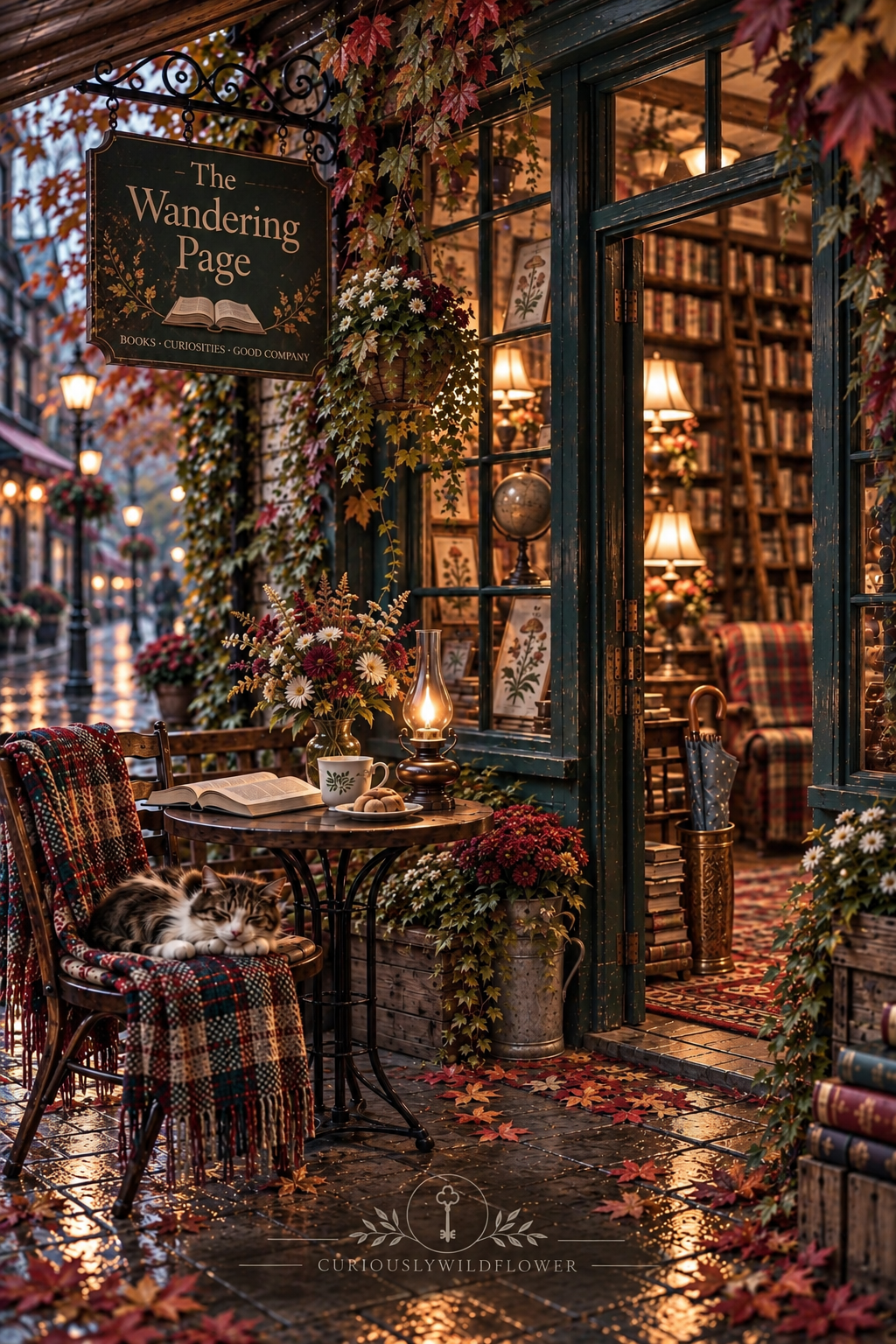
It had been raining all day, and by late afternoon, the little bookshop had settled into its usual quiet. The woman who came every Thursday for a new mystery had already left, and the gentleman with the battered leather satchel had lingered over his coffee longer than usual. Then there was the young woman. She’d spent nearly an hour on the same page, occasionally glancing out at the rain before finally closing her book. From his favorite chair, he watched her gather her things and disappear down the street. She’d forgotten her umbrella. No matter. He had a feeling she’d be back.
Arthur Bell had owned The Wandering Page long enough to know that people left things behind for all sorts of reasons. Gloves, reading glasses, shopping lists, once an entire birthday cake. He’d found the cake beneath a table on a particularly busy Saturday and spent the better part of an hour trying to determine whether it had been forgotten or deliberately abandoned.
The umbrella was a rather nice one. Dark blue, with tiny white dots and a curved wooden handle. Arthur retrieved it from the brass stand beside the door and examined it briefly before setting it behind the counter.
“Another one,” he remarked.
From the chair by the window, Dickens opened one eye, considered the information, and went back to sleep.
Dickens had appeared outside the shop one particularly miserable autumn afternoon, thin and thoroughly unimpressed with the weather. Arthur had offered him a saucer of milk, which the cat ignored, followed by a small piece of chicken, which he accepted. By the end of the week, Dickens had acquired a bed, a food bowl, and the unquestioned authority to occupy any chair he pleased.
Arthur had acquired a cat.
The rain continued into the evening. Arthur straightened a crooked stack of travel books, turned down the lamps in the back room, and checked that the kettle was empty. Before locking up, he placed the umbrella in the stand again, where it would be easy to find.
The following morning arrived bright and unexpectedly cold. Sunlight caught the last drops of rain clinging to the ivy above the shop windows, and a breeze sent a handful of red leaves tumbling across the pavement.
By half past nine, Arthur had already sold two paperbacks, argued with the delivery driver about a missing parcel, and discovered Dickens sleeping inside a box of newly arrived cookbooks.
At ten seventeen, the bell above the door rang.
The young woman stood on the threshold, looking slightly embarrassed.
“I think I left something here yesterday.”
Arthur glanced toward the umbrella stand.
“Depends. Are you looking for an umbrella or a birthday cake?”
She blinked, then laughed.
“An umbrella.”
“Good. The cake’s long gone.”
He handed it to her, and she turned the wooden handle between her fingers.
“I didn’t realize I’d forgotten it until I got home. Which is ridiculous, considering how much it was raining.”
“People tend to forget things when they’ve got something else on their minds.”
She looked up at him, and for a moment he thought she might say something. Instead, she smiled.
“I suppose they do.”
Arthur returned to the counter, leaving her free to go. He had learned years ago that people were much more likely to talk when they weren’t expected to.
But she didn’t leave.
Her attention had wandered to a small display beside the window, where Arthur kept books that didn’t fit neatly into any particular section. Old travel journals, illustrated collections of folklore, books about peculiar inventions and forgotten places.
“Do you choose all these yourself?” she asked.
“Most of them. Dickens has terrible taste.”
She followed his glance toward the cat, who was now sitting in the window with the expression of someone supervising a particularly incompetent employee.
“He’s beautiful.”
“Don’t tell him. He’s difficult enough.”
She crouched beside the chair and offered her hand. Dickens sniffed it carefully, then leaned forward to accept a scratch behind the ears.
Arthur raised an eyebrow.
“Well, that’s unusual.”
“Doesn’t he like people?”
“Oh, he likes people. He simply prefers they understand their place.”
She laughed again, and this time it seemed to come more easily.
Her name was Clara. Arthur learned this when she finally approached the counter with a slim green book about the history of forgotten gardens. She’d been living in the neighborhood for three weeks, having moved into a little flat above the florist two streets over.
“I keep meaning to explore,” she admitted, “but every time I go out, I end up walking the same few streets.”
“Nothing wrong with familiar streets.”
“No, I suppose not. It’s just that I moved here because I wanted something different.”
Arthur wrapped the book in brown paper, folding the corners neatly.
“And has it been?”
Clara considered the question.
“Not yet.”
He nodded as though she’d given him a perfectly reasonable answer.
“Three weeks isn’t very long.”
“No. I know.”
“Besides, you found the bookshop.”
She smiled.
“Twice, apparently.”
“That’s practically a habit.”
Outside, a gust of wind rattled the hanging sign. Clara glanced toward the window, where the sunlight had begun to disappear behind a bank of gray clouds.
“I should probably go before it starts raining again.”
Arthur looked at the umbrella resting against the counter.
“Well, at least you’re prepared this time.”
She picked up her book and turned toward the door, but stopped beside the chair where Dickens had settled himself once more.
“Goodbye, Dickens.”
The cat opened his eyes.
Arthur watched her leave, the little bell giving its familiar jingle as the door closed behind her.
He returned to the counter and noticed a small square of paper lying beside the till. It was the receipt from Clara’s book, and on the back she’d written something in hurried, sloping handwriting.
Thank you for making this place feel a little less unfamiliar.
Arthur read it twice.
Then he folded it carefully and tucked it into the drawer beneath the register, where he kept a collection of things that mattered more than their owners probably realized.
By noon, the rain had returned.
Arthur made himself a cup of tea, settled into his favorite chair, and opened the novel he’d been trying to finish for nearly a fortnight. Dickens climbed into his lap, turned around three times, and arranged himself directly across the open pages.
“You’re an absolute nuisance,” Arthur told him.
Dickens purred.
Through the window, Arthur watched the rain fall over the little street. The florist was bringing her chalkboard inside, and the gentleman with the battered leather satchel was making his usual slow progress toward the corner café.
Arthur reached for his tea.
He suspected Clara would be back.
And next time, perhaps, she’d stay long enough to finish her book.
Leave a Reply